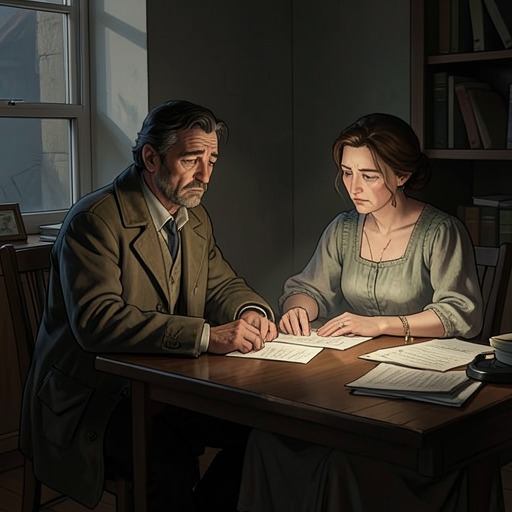
Karl-Heinz
The Disappearance of Josef MengeleKarl-Heinz is Martha Mengele’s son, Josef Mengele’s nephew, and a child drawn into the false family identity Josef constructs while living under an assumed name. The narrative shows him first as one of two disciplined boys who look up to the man they know as Uncle Fritz, then as a supposed son presented to the public in Buenos Aires. In 1960, he leaves South America with Martha while Josef disappears across the Brazilian border, making his place in Josef’s household both intimate and provisional.
Identity and Introduction
At Hotel Engel in Engelberg, Karl-Heinz arrives with his mother, Martha, and Rolf, Josef’s son. The boys are both twelve. The scene establishes the family’s unusual arrangement through their introductions: Rolf has been told since early childhood that his father Josef died in combat in Russia, while the man now among them is presented as Uncle Fritz from America. Karl-Heinz, by contrast, is Martha’s son and Josef’s nephew. The shared label of uncle gives the boys a common figure of authority without making their actual positions in the family the same.
The narration does not describe Karl-Heinz’s private response to these identities. Instead, it records the outward form of the household: the boys sit straight at table, speak only when authorized, and treat Uncle Fritz as someone to admire. That distinction matters. Their disciplined conduct is visible; what either boy understands about the adults’ arrangements is not established here. Karl-Heinz’s characterization therefore comes less through disclosed thoughts than through the roles assigned to him and the routines in which he participates.
Life with Uncle Fritz
Karl-Heinz and Rolf are described as punctual and disciplined, and both look up to Uncle Fritz. They enjoy his stories and urge him to tell more at dinner, on walks, and in the evenings. His authority is reinforced by the image he presents of himself as a world-class skier who served with Alpine troops. The stories make the visiting man a source of adventure and instruction, not merely a relative staying with the family.
The boys’ interests are differentiated. Karl-Heinz wants accounts of tank battles, heroism, and comradeship on the dusty steppes of Russia. Rolf is more captivated by South American history and tales of gauchos and Indigenous peoples. Uncle Fritz accommodates those different appetites, but his storytelling also carries a political message: he compares the conquest of the Argentine desert to German expansion in eastern territories and presents both as a triumph of civilization over supposed barbarism. He tells the boys that Germans were more talented than the Greeks and stronger than the Romans. Karl-Heinz’s attraction to military stories thus places him within a household where entertainment and ideological instruction are delivered together. The evidence shows his interest in the tales, but does not establish that he adopts or later repeats their claims.
Josef’s own view of the boys is not even-handed. He privately decides that Rolf needs to be taken in hand and links toughness to masculine worth, judging that Martha and a shoe merchant in Freiburg will not make Rolf sufficiently tough. This judgment clarifies the authority Josef claims over the children, but it is specifically about Rolf. Karl-Heinz is present in the same household and shares its strict table manners and admiration for Uncle Fritz; the account does not say that Josef singles him out for the same intervention.
Family Role in Buenos Aires
When Martha and Karl-Heinz arrive in Buenos Aires, Josef obtains a loan and buys a coveted house with a garden and swimming pool, adjoining Juan Perón’s former private residence. The move makes the family arrangement more public and settled than the hotel visit in Switzerland. Martha is entered in the directory, and Karl-Heinz is introduced as Josef’s son, converting his actual relationship as nephew into a convenient public identity.
That presentation belongs to Josef’s wider effort to regularize and remake his life. In 1956 he had provided the West German consulate with information that disclosed who he was, received official documents in his own name, and then obtained Argentine residence papers and a German passport. The family’s presence in Buenos Aires accompanies his emergence as a respectable bourgeois. For Karl-Heinz, the concrete consequence described is a changed public place in the household: he is represented not as Martha’s son and Josef’s nephew, but as Josef’s son. The narrative gives no account of whether he knew how this representation related to Josef’s concealed past.
Separation and Narrative Significance
By September 1960, Josef believes that he must flee because Israeli agents are closing in. The surveillance monitors the comings and goings of his wife and son, while approaching Krug’s farm. Josef receives a Mauser pistol and a Brazilian identity card in the name of Peter Hochbichler from Hans-Ulrich Rudel. He must separate from Martha and Karl-Heinz; they return to Europe without saying goodbye to him. The account specifies the separation and its circumstances, but offers no dialogue or description of Karl-Heinz’s reaction.
At dawn on a clear October morning, Alban Krug and Hans-Ulrich Rudel drive Josef to the Brazilian border. Josef burns his notes and German passport and destroys his Auschwitz specimens before leaving. Karl-Heinz is not with him on that final journey: he has already departed with Martha. The contrast is stark between the family identity publicly fashioned in Buenos Aires and the hurried dismantling of Josef’s life as he flees. Karl-Heinz’s role in the story is limited but consequential: his presence helps define the fugitive’s constructed household, and his return to Europe marks the point at which that household breaks apart.